May my exploration of faith be a blessing to others.

Sunday, July 24, 2016

Cathechism: Prologue I.1 To Know and Love God

Part 2 in my continuing exploration of the Catechism of the Catholic Church, 2nd edition

Prologue
I. The Life of Man--To Know and Love God
1. God, infinitely perfect and blessed in himself, in a plan of sheer goodness freely created man to make him share in his own blessed life. For this reason, at every time and in every place, God draws close to man. He calls man to seek him, to know him, to love him with all his strength. He calls together all men, scattered and divided by sin, into the unity of his family, the Church. To accomplish this, when the fullness of time had come, God sent his son as Redeemer and Savior. In his Son and through him, he invites men to become, in the Holy Spirit, his adopted children and thus heirs of his blessed life.

The Creation of Adam, from the Sistine Chapel, by Michelangelo
via Wikipedia Commons
As most Christians know, in the beginning God created the heavens and the earth, and the night and the day, and the birds and the fishes, and all the creatures. And, then he created man (which in our modern understanding means "humans," not just dudes). This is how the Bible starts--at the very beginning, which isn't "the" beginning at all since God is infinite and is always existing. This is merely the beginning of us humans. God created man the Catechism says out of "sheer goodness." Of all of his creations, man is the only with free will, and this enables us to choose to love God or not.

In trying to answer the question, "Why did God create man?", it would be easy to anthropomorphize him. Genesis says that God created us in his own image, and we intend to interpret that in a fairly literal sense. More specifically, we translate this statement with transitive powers: if man is like God then God is like man. Most Western religions even depict God looking like a human, albeit a generally older, wiser man (of course!) That makes it even easier to assign human emotions and motivations to Him. In different parts of scripture, He is characterized as jealous, angry, loving, compassionate, peaceful, faithful, gracious, merciful, wrathful, etc. etc. (Frankly, putting all of these adjectives together makes me think of the characteristics assigned to the pantheon of Greek and Roman gods or of other polytheistic religions.)

From there it is easy to suppose that God made man from some need to be loved or worshiped by someone who had a choice rather than just the angels. In this part of the Prologue, we see that God wants us to be close to him and to be unified with each other. Every Catholic question-and-answer site recites that man is intended to "know, love and serve" God. This answer leaves me feeling like a young child when I drove my parents crazy asking, "Why? Why? Why?" I accept that I am supposed to know, love and serve God. I really believe that is a given. But WHY does he want us to know, love and serve him? Through all of my searching and inquiries, there always seems to be another "why." We are always thirsty for the truth behind the truth. We always believe there is more to the story. But, just as our parents often ran out of responses to our incessant questioning, maybe the best answer for now is simply, "because."

I am made in the image of God, but I don't think that means I look like him. I cannot fully comprehend the nature of God and perhaps it is also equally as difficult to understand the nature of man. I have sometimes wondered if the way we are like God is that we exist in "three persons" too: mind, heart and soul--or as in the Trinity: Father, Son and Holy Spirit.

The fact that the Trinity is also referenced right here in the beginning of the Catechism makes that wonder even stronger. These three are united; God longs for us to be united with each other and in him. Many religions and philosophers throughout the ages and across cultures have some kind of unity at the core of their beliefs: we are all one. Sometimes these theories of one-ness include not just humanity and deities but animals, plants, minerals and the entire cosmos.

This first statement of the Catechism calls our attention to our need to be reconciled to God and with God. It is the central tenet of our faith. We may always have a surface-level understanding of God and his desires for us, but we must strive always to know, love and serve him. Perhaps even as we transition from this physical world, we may not know all of the whys, but I must trust God enough to let the answer be, "because."

Sunday, July 10, 2016

Making the Sign of the Cross

Kremlin.ru via Wikimedia Commons
You can always tell when a movie character is supposed to be Catholic: at some point or another, he will make the Sign of the Cross. For those raised outside of this tradition, it was certainly a foreign act, which we perceived somewhere along the scale of silly and useless to exotic and interesting.

Making the Sign of the Cross is common among the various Catholic and Orthodox Christian churches. Albeit some cross themselves left to right (like the Roman Catholics) while others go right to left (like the Eastern Orthodox). Some Protestants (like Episcopalians, Methodists and Lutherans) also use the Sign, but it is much more closely associated with the older Christian faiths and is used more regularly among their followers.

Whether you have a Bishop or Priest bless you with the Sign of the Cross or you cross yourself, the act is what the Church calls a "sacramental." This means that it is a symbolic action that serves as a means of receiving sanctifying grace. In simple, everyday terms it is a reminder of all you have professed to believe--I've seen it referred to as a "mini Nicene Creed"--that can be used as both a blessing and a prayer.

For Catholics and some others, it is used throughout the worship service and the Mass. Most Catholics will cross themselves with Holy Water upon entering the Church and again, while genuflecting, before taking a seat in recognition of the physical presence of the Blessed Sacrament. The Celebrant will use the Sign of the Cross to bless the congregation several times throughout the Mass, especially at the end of prayers. The congregants will mirror this action by crossing themselves. They will also make a smaller Sign of the Cross over their foreheads, lips and hearts before the reading of the Gospel and will cross themselves after receiving the Host. After the Mass, most will genuflect and cross themselves before leaving their seat and one final time with Holy Water before exiting the Church.

By adriatikus via Wikimedia Commons
But what does all this arm waving mean? Like all sacramentals, the Sign of the Cross is steeped in tradition and symbolic meanings. The proper way to do it is with the first two fingers and thumb extended and touching each other represents the Trinity, while the last two fingers touching the palm signifies the dual nature of Christ as both God and Man. The movement from the forehead across the heart and down to the stomach and then from one shoulder to the other is also packed with meaning: a consecration of our minds, hearts and actions to God while tracing the ultimate symbol of Christ's sacrifice, the cross.

Of course, you don't have to be in Church to use the Sign of the Cross. Catholics are encouraged to use it to dedicate their actions to God, as a blessing on people and objects (like meals!), and as a protection against evil (since the Devil hates the Cross). So you can use it in your own prayers and at the beginning of any activity whether that's starting a new project at work, cooking dinner or playing a game of tennis. As one person posted on Catholic Answers Forum"Good gravy, when is it NOT appropriate?!?"

In my daily life, I also use it as I pray for others. I have established "reminder" cues to encourage myself to pray for the well-being of others. So, I cross myself to invoke the protection and blessing of the Father, Son and Holy Spirit when I pass a hospital or hospice where people are suffering; when I hear a siren indicating that people are in danger; when I see someone stopped by the police so that each side of that interaction may be safe; when I see a young parent walking with children that they may have all of the necessities of life; and when I see a disabled vehicle or an accident so that those impacted will be safe and will have the ability to bear the financial burden of the incident.

My Cradle-Catholic husband crosses himself at similar moments and he also uses the Sign of the Cross when passing any Catholic Church. Just as many Catholics cross themselves upon entering the presence of the Blessed Sacrament, many like my husband pause to recognize that they know the Sacrament is nearby. He will also cross himself near cemeteries to pray for the dead, especially his own parents, and to solicit their intercession on behalf of those still here.

The sacramentals and symbols of the Catholic Church are a great part of the Church's attraction for me. By using the Sign of the Cross, I am not only going one step further than just thinking good thoughts for others, I am also providing a visible sign to those who may see me. Whether in a restaurant, in my car, or on the street, the Sign of the Cross can be a powerful reminder to others that we all should draw closer to God.

-------------------------
For more about this topic, I recommend:

-------------------------
From the Catechism of the Catholic Church:
1235 The sign of the cross, on the threshold of the celebration, marks with the imprint of Christ the one who is going to belong to him and signifies the grace of the redemption Christ won for us by his cross. 


1671 Among sacramentals blessings (of persons, meals, objects, and places) come first. Every blessing praises God and prays for his gifts. In Christ, Christians are blessed by God the Father "with every spiritual blessing."177 This is why the Church imparts blessings by invoking the name of Jesus, usually while making the holy sign of the cross of Christ. 


2157 The Christian begins his day, his prayers, and his activities with the Sign of the Cross: "in the name of the Father and of the Son and of the Holy Spirit. Amen." The baptized person dedicates the day to the glory of God and calls on the Savior's grace which lets him act in the Spirit as a child of the Father. The sign of the cross strengthens us in temptations and difficulties.

Sunday, June 19, 2016

Something About Mary

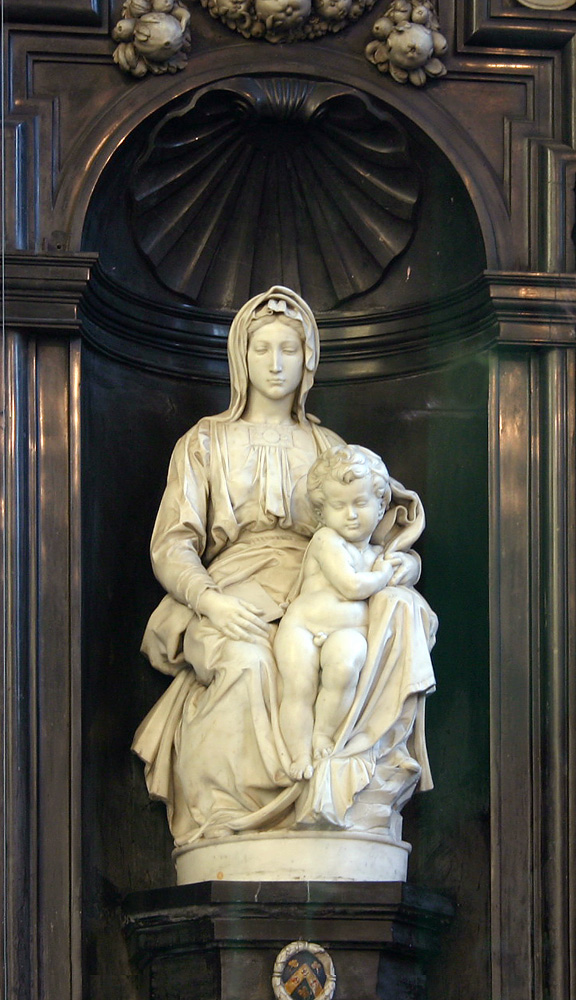
Madonna and Child by Michelangelo
via Wikimedia Commons
Several months ago, my husband and I unexpectedly visited a church in a different part of town. When we walked in, a choir was already singing. Their style was a bit different from any Catholic choir we had heard before--it was strongly influenced by the most lively old Negro spirituals of the South. My cradle-Catholic husband, who had only ever associated this music with Baptists or Evangelicals or other such Protestants, turned to me and asked, "Did we come into the right church? Are you sure this is a Catholic church."

"What do you see on the right side of the altar?" I asked.

"The Virgin Mary," he responded.

"This is certainly a Catholic church," I told him. (After all, I knew we weren't in the only Orthodox church of our community.)

It is perhaps ironic that Mary was one of the things that kept me from the Catholic Church in the earliest days of my spiritual awareness, but ultimately was also one of the people who attracted me to it. As a young teen, I had attended a Rosary for the mother of one of my friends. I was perplexed by the repetition of the prayer. "How sad," I thought, "They think they aren't being heard." Of course, it was also odd to me that anyone would pray to or through Mary. It was just not part of my understanding. Then, on an episode of the 1980s sitcom "Gimme a Break!" I heard Nell Carter sing the Bach-Gounod version of the Ave Maria. I had never heard anything so beautiful. Her character sang it to soothe and calm the other characters who had just experienced an earthquake. I began to understand the power of that simple prayer--the lyrics of which are drawn entirely from the Gospels. I learned the words, and I began to pray it every time I flew in a plane. It was a comfort to my anxiety during take off and landing.

Only later did a I come to focus more on Mary herself. As a great admirer of Pope John Paul II, I started to see her through his eyes. Having lost his own mother as a child, the Pope was a great devotee of Mary as the only mother he had. As a budding feminist or post-feminist in college, I thought, "Why shouldn't we have a spiritual mother as well as God the Father?"

I began to think, if I'm going to be a Christian, I should adopt the full breadth of Christianity, which I saw as Catholicism. And, if I were going to be a Catholic, I should fully embrace that too and become a Marian. So, now I am trying to learn more about her, about her role in the Gospels, in Salvation history, and in the growth and development of the Church.

I came to view Mary as the first Christian. Not only was she the first to understand and accept Christ's role, but her faith never wavered. Even when the disciples ran away, even when Peter three times denied Jesus after swearing that he was prepared to die with Him, even as they panicked over the empty tomb, and fretted in the Upper Room, Mary's faith never wavered. She gave herself, body and soul, to God in a way that no one else ever has.

Annunciation by Fra Angelico via Wikimedia Commons
I recently read a Lutheran posting about Mary that started by saying, "It's hard to understand all the fuss about Mary." It went on to state that Mary was a fairly unimportant person in the Bible and, when she did appear, she was entirely passive. Unimportant? How could anyone think that for a moment? There is no Incarnation without Mary. The story of Jesus as human begins with Mary's acceptance. From the moment the angel says, "Hail full of grace, the Lord is with you," she is an active participant in what was to come. Her acceptance of this very strange announcement was anything but passive. In accepting, she was risking her reputation, her future, her place in her family and in her society, perhaps even her life. She could easily have been cast aside by her fiance Joseph. In fact, she nearly was until an angel appeared to him as well. She could have been exiled by her family, condemned and executed by the leaders of her community. Yet, Mary's response was "I am the handmaid of the Lord; let it be to me according to your word."

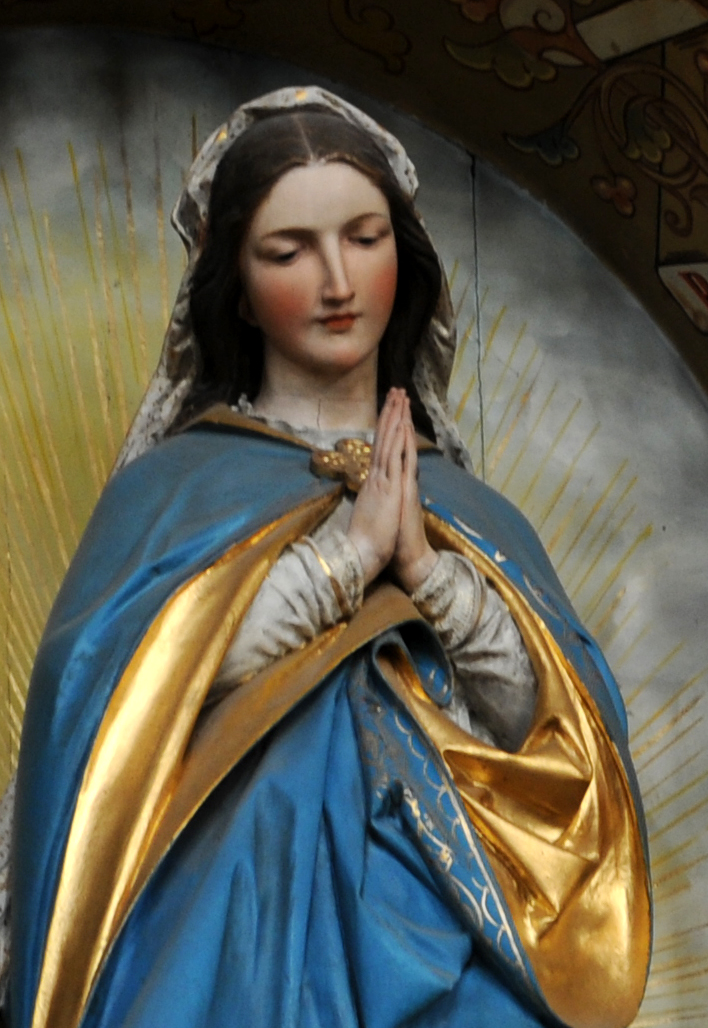
Mary by Josef Moroder via Wikimedia Commons
As Mary nurtured her Holy Child, she remained watchful and faithful. She saw all that He did and all that happened to Him, and the Bible says, she ponders these things in her heart. She is constantly thinking and wondering, but always trusting. When Jesus is fully adult, it is his mother Mary who actually launches his "career" at the wedding at Cana. It is Mary who insists he perform this first public miracle, even after Jesus tells her that His time has not yet come. In response to his protest, knowing who He was and why He had come, she turned to the waiters and instructed them to do whatever He told them to do. And so, He did as His mother had instructed Him.

Her instruction to the waiters is the same as her instruction to all of the children of God: "Do as He says." That is hardly a passive role. It is the most active role possible. By her word and by her example, we are told to follow Him with full faith despite any troubles that may befall us, because as the angel told her, all things are possible with Him.

Friday, February 26, 2016

Fast Food Fridays

If you are struggling to figure out what to eat when:

  1. It's Lent.
  2. It's Friday.
  3. You're in a hurry.

You are not alone. Last week, I had to remind my husband a couple of times not to eat meat. I finally sent an instructional text offering him two lunch options to choose from: baked potato and salad at the Wendy's near his job or a tuna sandwich at the Subway. A couple of years ago, I found myself in a situation when I scheduled a lunch date at Steak n Shake. I mean, "steak" is in the name and there is not much there to choose from unless you want to make a lunch of French fries. Not only is that not balanced or healthy in way, but I'm also not really a fries fan. One time, I actually told a server to bring me just five French fries. In addition to a strange look, I also got a plate full of French fries.

So, I thought I'd make a quick rundown list of Lent-friendly options for the next time you find yourself in similar situations.

BREAKFAST

Breakfast is actually super easy. Many of the fast food places have pancakes or oatmeal or bagels with cream cheese. Even if they don't, you can order a breakfast sandwich just about anywhere and have them leave off the bacon, ham, sausage, etc. Remember, cheese and eggs are okay so you can eat them on a muffin, a croissant, a bun, a bagel, a biscuit or whatever your preferred choice is. Here in the South, you can sometimes get grits.

LUNCH

I'm going to break it down with a choice or two from most of the main chains or types of restaurants.

Sandwich shops: Almost all offer a tuna sandwich or a veggie sandwich.

Pizza places: Order just cheese or load it down with mushrooms, olives, peppers, onions, etc. You can even have anchovies, if you are into that.

Fish sandwiches: You can now find fish sandwiches at most of the major chains. Of course, McDonald's has had the Filet o' Fish forever, but Burger King, Wendy's, Carl's Jr./Hardee's and even Arby's and Dairy Queen now have fish options. Jack in the Box even offers a fish and chips option in addition to its sandwich. DQ also offers additional local menu items, which could include shrimp in your area. (Plus, you can still have ice cream--just don't over do it.)

Fish restaurants: The choices are obvious here since most of their options are meat-free, although several of these chains do have a chicken choice (just stay away from that one). However, if you are sick of fish, remember these places often offer shrimp, clams or even stuffed crab.

Mexican options: Fast food "Mexican" or Tex/Mex is one of the easiest places to find Lenten options. Taco Bell has even been known to put up a special Lenten menu to highlight these items on their menu. You can order almost any kind of burrito, taco, enchilada, etc. without meat by sticking to beans and/or cheese. A bean burrito is one of my favorite choices, even when it's not Lent.

Wendy's: As mentioned above, Wendy's baked potato with side salad makes a filling combination.

KFC: Chicken is the heart of KFC, and they actually do not offer any entrees or sandwiches without chicken. However, I am a fan of both their mashed potatoes and their macaroni and cheese. Order some mac and cheese with their green beans or cole slaw and you have a satisfying and balanced Lenten meal.

Chick fil A: Another restaurant devoted to the chicken with no non-chicken entrees. However, they do offer a meat-free side salad and you actually can have their chicken soup. I don't know why but soups and broths are not included in the Catholic definition of "meat."

Not on the menu: Unfortunately, I could not find any Lent-friendly options at one of my faves, Sonic, unless you want to make a meal out of mozzarella sticks (which I admittedly have done) or cheddar poppers.

A word about salads: If you order a fast food salad, be aware that many of these come with some kind of chicken or other meat, so be sure to order without that.

DINNER

Of course, you can repeat any of the ideas above for dinner and apply them to casual or fine dining restaurants. Also, if you are invited to a catered banquet or dinner, don't forget that the chef probably has also prepared a vegetarian option, which you can request. My husband and I attended a banquet last week and requested the veg option. We ended up enjoying a spinach stuffed tomato with green beans and a nice risotto. Other common vegetarian catering options include mushroom or eggplant as the featured entree. And, remember, it is not the Church's goal to make things very difficult or to give offense to others. So, if you have no other option and/or don't want to upset your host, eat what you are served. (In my business, I often have to eat things I don't like even on normal days, so I promise, it won't kill you!)

Saturday, February 13, 2016

Why Do You Want To Be Catholic?

The Last Supper by Ambrosius Francken via Wikimedia Commons
This week I spent half a day in the Emergency room with my mom after she had a severe asthma attack. (She is okay now.) As soon as she was able to talk again, she immediately began lengthy conversations with every nurse, tech, volunteer or doctor who entered her room. That's my mom--if you are within her eyesight, she will learn your life story and you will learn hers. Guaranteed. Doesn't matter where she is or whether she can even breathe properly. It is her special gift.

When one nurse casually remarked that she was trying to be a "good Catholic girl," my Baptist mother began to explore the lady's faith and life. We learned about her education, her career history, her plans for the future, her husband's health and his career. (I told you,my mom is very thorough!) When the nurse told us that she had recently moved to our town, my mom immediately began recruiting her to my church! When she shared that she had been "born Baptist," my mother exclaimed, "so was she!!!!" gesturing proudly at me.

Mom told her all about my conversion and how great my priest is and how wonderful she thinks the Sister who runs the RCIA program in my parish is. (My mother is the kind of mom who thinks EVERYTHING about her children is the BEST! People and things around us are also the best by association.)

As amazing as my mother's incredible PR job for the Catholic church in general and my parish in particular was, the most amazing moment came when mom asked the nurse why she had converted. "You just know when it's right," she responded.

That's exactly how I felt. Like me, her first real encounter with Catholicism happened when she accompanied a friend to Mass. Also like me, she was first attracted to the reverence of Catholic worship. And, also like me, she takes comfort and joy in knowing that Catholics everywhere around the world are reading the same scriptures and praying the same prayers. At the same time! There is a joyful resonance in the feeling of that powerful connection across distance, culture, race, politics, economics. It is the actual meaning of the word "catholic."

According to Dictionary.com, "catholic" means:

1. broad or wide-ranging in tastes, interests, or the like; having sympathies with all; broad-minded; liberal

2. universal in extent; involving all; of interest to all

This unity of spirit helps bring me closer to God. I feel reassured that our history, though troubled at times, stretches directly back to Jesus as He taught the Apostles, and even earlier than that to Abraham, Isaac, and Jacob/Israel. I am strengthened by the idea of the Apostolic succession, that once Jesus told Peter, "you are my rock, upon you I will build my Church," that that is exactly what happened. Then, for almost 2,000 years that awesome responsibility has been passed from Peter to pope to pope.

© Marie-Lan Nguyen / Wikimedia Commons, via Wikimedia Commons
The Church has not been perfect. We cannot take pride in things like the Inquisition, the scams of indulgences, and various corrupt leaders over the centuries. But, at the very heart of it, we have this real, physical connection to Jesus. He touched the Apostles, who touched their disciples, who passed that loving touch down to us. Each time, the minister gives me the Host, the miracle of transubstantiation is not just the bread becoming flesh but the passing of that Eucharist directly from Jesus at the Last Supper in the Upper Room at the dawn of a new age  to me in a church in a small southern American city two millennia later.

So, I hope that each of us will invite our friends to come with us to Mass so that they also can discover this universal connection to God and each other that is also very personal. All are welcome. Including nurses, techs, volunteers, and doctors--and if my mother keeps it up, they all will soon be converted!

Tuesday, February 9, 2016

Beginner's Guide to Lent

Fast. Abstain. Penance. Almsgiving. Terms like these may seem archaic, unnecessary, confusing or even scary to the newly initiated, especially as we enter the Lenten season. For those of us who were not raised Catholic, it can be challenging to figure out what's going on, what is expected of you and how to do it. The good news is that all of these observations and tradition, are a lot less stringent than you might think. The Church does not expect you to go on a hunger strike, never eat meat, give up all of your favorite activities, or give away all that you have. The guidelines are actually not terribly difficult and can help deepen your connection to God and to the crucifixion and resurrection.

What is Lent? 
Lent is the 40 days (not including Sundays) when we mirror Christ's 40 days in the wilderness as a time to focus on our spiritual wellness and to deepen our faith and understanding. It is a time of reflection, repentance, and service to others. Sundays are not included because we celebrate Christ's resurrection every Sunday. Sundays are a day for rejoicing not sorrow as we unite with God and each other through the Eucharist. To assist in your reflection and to build discipline, the Church calls on you to pray, fast, abstain, and participate in almsgiving.

Fasting
I used to think that fasting meant not eating at all but this is not the case. The Church defines fasting as eating only one (meatless) meal a day and you can supplement this with two snacks. This sacrifice is intended to help you focus on your spiritual hunger and to realize your blessings. It is not meant to be a punishment or to cause you physical harm. In fact, if you have an illness or condition that requires you to maintain certain dietary requirements like diabetes or pregnancy, you should modify your fast as needed or not fast at all. Otherwise, during Lent, you should observe a fast on Ash Wednesday and Good Friday.

Abstaining
In today's world, we often hear the word 'abstain' in reference to sex. That's not what this is about. Rather, it is about abstaining from consuming flesh. This means that you avoid the meat of warm-blooded creatures: mammals (cows, pigs, deer, etc.) and fowl (chicken, duck, turkey, etc.). However, you can still eat their products like milk, eggs, butter, sauces, and gelatin. You can also eat cold-blooded creatures like fish, frogs, shrimp, alligator, etc. The specific reason for not eating flesh is to show respect for the sacrifice of Christ's flesh. That's why most of Catholic world abstains on all Fridays--the day we remember the Crucifixion. In the U.S., however, the Bishops got the Pope to excuse from this in return for offering more good work. (So, if you don't abstain on Fridays, you are supposed to be extra charitable.) During Lent, we are expected to abstain from meat on all Fridays. 

Exceptions
As mentioned above, you should not participate in these penitential acts if they are harmful to your health or the health of your child in the case of a pregnant or nursing mother. You are not expected to fast until the age of 18, although you should abstain beginning at age 14. People aged 60 and older are excused from both. You are also permitted to break your fast or abstinence if observing it would cause offense to a host. For instance, if your boss invites you to dinner and serves you steak, you can eat it. 

Giving Something Up
The Church does not regulate the longstanding tradition of giving something up during Lent. The Church views these penitential acts as a disciplinary observances that can help the individual focus on the meaning of the season. Many people choose to give up something they love, like chocolate or candy, or something that is harmful to them, like smoking, or bad habit, like oversleeping. Others, select to give up a particular comfort or vanity item (like sleeping pillows or wearing makeup). Whether you choose to forego a particular food or habit or comfort, you should not choose something that is going to be so difficult that it will result in frustration or anger. (The year I gave up sodas, I was depressed and mean and not even interested in eating at all during the last 10 days!) Again, the purpose of all of these penances is not to actually punish yourself, but to discipline yourself. So, you can indulge in whatever you have surrendered on Sundays if you wish. However, if you are truly trying to discipline yourself into a new habit (like not smoking), taking a break once a week could undo that effort.

Almsgiving
We are called at all times to be charitable, whether through contributions of money, goods, services, or time. During Lent, we are asked to increase our charitable practices. You can do this by contributing to special appeals, identifying a new cause you'd like to support, volunteering more, or making more time for others. If you don't have money to spare, clean out your closets and donate those clothes you don't wear. Volunteer to help at the local shelter or spend a Saturday visiting people in a retirement community. Or, you could make an extra effort to say thank you by making a meal for the people you work with or reaching out to family or friends you've lost touch with. Remember, Jesus washed the feet of the apostles. If He can do this, there is no charity too low or too small for you.

What else can you do?
If you want to really step up your observations during this time, go to Mass more frequently. Even if your parish does not offer daily Mass, there is likely a church in your area that does. You could also make an effort to attend all of the special Masses of the season: Ash Wednesday, Holy Thursday, Good Friday, and the Easter Saturday Vigil--which is when we welcome new Catholics into the church. If you live in a city that is the base of a bishop or archbishop, you can also attend the Chrism Mass during the week before Easter. All of the priests of the diocese participate in this ceremony, reaffirming their own commitment and blessing the holy oils that will be used throughout the upcoming year. If you have the resources, go to Jerusalem or to the Vatican--I think we should all do this at least once in our lives. You can also pray more by attending Stations of the Cross, Rosary, or Novena or performing an Adoration. Join a study group, read the daily readings, study the Catechism, or watch or listen to Catholic programming--EWTN.com can provide you with schedules and programs. (When I am too ill to go to Mass, I always tune into one on the local EWTN station.)  And, don't forget reconciliation. There is no better time to repent and seek forgiveness than now.

Sunday, November 22, 2015

The End is Near, and It Always Has Been

I grew up in a variety of Protestant faith traditions, but during my early adolescence my family attended a church that is part of the Christian and Missionary Alliance, which builds much of its mission on the doctrine, "go ye into all the world and preach the gospel." We worked to support missionaries abroad and I can remember the excitement when missionaries would come to our church to share their personal stories and raise money to support their work. They were bringing people to Christ and improving the lives of people all over the world.

Another central tenet of the CMA, like most evangelical Protestant churches, is about the "end times," which they believe is foretold in the Bible through many signs. These end times will be heralded by political turmoil and natural disasters before the faithful are caught up in the "rapture" followed by the "Tribulation" during which time the world will be led by an evil Antichrist. These teachings were always strongly disturbing to me. Although I had been "born again" and baptized by full immersion according to the traditions of the CMA, I was terrified of the rapture. We were shown films that only reinforced my terror. Since then, there has been a tremendously popular series of "Left Behind" books and movies (starring Kirk Cameron) built around these ideas.

One of my most vivid childhood memories was a Saturday afternoon when, as usual, I was dawdling about getting ready to go somewhere with my family. Tired of waiting on me to paint my nails, my family went outside, saying, "we'll be in the car." Several minutes later, I finally felt presentable and dashed out the door to join them. But they were gone. The car was there, but my family was nowhere. In fact, I could not see anyone anywhere. I did not even hear any car in the neighborhood. I was CERTAIN that I had been left behind. I repented and cried, panicked and called out for my mother and for God. I don't know how much time elapsed. An eternity, at least. Then, I heard my parents laughing--at the neighbor's house!

The trauma of that moment has always troubled me.

I imagine that I behaved very well and prayed more than usual for a long time after that, but eventually these ideas about the rapture and tribulation began to to make less sense to me. Over the years, I heard many preachers and others confidently predict the end of the world, and yet it never ended.

When I began to explore Catholicism, I realized that not all Christians have the same beliefs about the end of the world. I had always wondered how anyone could believe the the Book of Revelation was a literal outline of things to come. Rather, the Catholic Church believe that it is apocalyptic literature. Likewise, I had been puzzled by the idea that every word of the Bible is literally true, when parts of the Bible contradict other parts of it. How could we say that we must literally follow the Ten Commandments but not the Mosaic dietary restrictions of Leviticus?

Once I understood that the Catholic Church does not interpret the Bible literally, it all made more sense and my faith was no longer troubled by such inconsistencies.

So, what does the Catholic Church believe about the "end times." First, the Church teaches that no one knows or can predict when the actual end of the world will come. Jesus says this in Matthew 24:36--this is one of those things that literal readers seem to ignore when they are telling us about the signs of the times and setting forth deadlines for Christ's return.

Second, the Catholic Church says that we have been in the end times since Christ's Ascension. Although the Bible refers to a thousand years, Catholics understand that a "millennium" meant a really long time to the Hebrews, not actually and precisely 1,000 revolutions around the sun.

Third, less formally, Catholics are told that the end of THE world should not be more important to us than the end of OUR world. For, our temporal existence will certainly end whether Christ returns during our lifetime or not. We must always be in a state of spiritual readiness, because we cannot know when we will be called from this world.

Finally, like the members of the Christian and Missionary Alliance, we are called to support, promote and participate in evangelization. This has been a particularly strong and recurrent message from the current Pope Francis.

For more about Catholic beliefs regarding the end times:

End Times, Millennium, Rapture on EWTN.com
End Times will bring greater persecution to Christians, says Pope on CatholicNewsAgency.com
What Do Catholics Believe about End Times? on ForYourMarriage.org